El Vacío. Reflexiones en torno a su experiencia y posible relación con el campo del diseño arquitectónico
Abstract
The interest in the Void stems from the mystery and the variety of meanings with which the term is used within the architecture field, both in academia and in professional practice.
This research aims to analyze the complex notions of the Void and its interaction both in the intellectual realm and architectural practice. This analysis is carried out through various disciplines, such as philosophy, sociology, art, psychology, and architecture, among others. In this sense, an attempt is made to have a broad panorama and understand the presence and influence of the term's diverse meanings within the architectural design field. All this in order to obtain a probable approach to its understanding and relevance in the experience of the human being.
The "subject-object" relationship is explored. That is, the various ways human beings experience the Void and how this encounter takes place. All this in order to have a better overview of the term and understand how this experience occurs. Finally, the focus is directed to the punctual by exploring the possible relationship of the Void in the processes that occur within the Architectural Design field, highlighting the importance of considering the socio-cultural and perceptual aspects.
References
Bollnow, O. F.. (1969). Hombre y espacio. Traducción Jaime López de Asiain y Martín. Barcelona, España: Editorial Labor, S.A.
Espuelas, F. (1999). El claro en el bosque. Reflexiones sobre el vacío en arquitectura. Barcelona, España: Fundación caja de arquitectos.
García Olvera, H. & Hierro Gómez, M. (2016) Aproximación crítica a las ideas de la producción de lo arquitectónico. Volumen 5. Colección Lo Arquitectónico y las ciencias de lo humano. UNAM. México; 2016. Pp. 153.
García Olvera, H. & Hierro Gómez, M. (2016). Un acercamiento revisor a las nociones del diseño en la producción de lo arquitectónico. Volumen 6. Colección Lo Arquitectónico y las ciencias de lo humano. México: UNAM.
Hammershøi, Vilhelm.(1906) Street in London. [Pintura] Dinamarca. Reproducción con permiso de “Ny Carlsberg Glyptotek, Copenhagen” . Créditos fotografía: : Ny Carlsberg Glyptotek, Copenhagen / Anders Sune Berg.
Hammershøi, Vilhelm.(1905) Interior. Strandgade 30. [Pintura] Dinamarca. Imagen de dominio público. Forma parte de la colección de la Galería Nacional de Finlandia. Imagen recuperada en: Monrad, Kasper. Hammershøi and Europe. Prestel. Inglaterra, 2014. Pág. 23.
Heidegger, M. (2009). El arte y el Espacio. Traducción Jesús Adrián Escudero. España: Herder.
Heidegger, M. (1994). Construir, habitar y pensar. Trad. Eustaquio Barjau. Publicado con fines académicos en Conferencias y artículos Serbal; Barcelona.
Janiaud, J. (2014). Simone Weil, la atención y la acción. México: Editorial Jus.
Monrad, Kasper. (2014) Hammershøi and Europe. Inglaterra: Prestel.
Lipovetsky, G. (2002). La era del vacío. Ensayos sobre el individualismo contemporáneo. Traducción de Joan Vinyoli y Michele Pendax. Barcelona, España: Editorial Anagrama.
Merleau-Ponty, Maurice. (1984) Fenomenología de la percepción. Traducción Jem Cabanes. Barcelona, España: Editorial Planeta – Agostini.
Merleau-Ponty, Maurice. (2010). Lo visible y lo invisible. Traducido por Estela Consigli y Bernard Capdevielle. Buenos Aires, Argentina: Editorial Nueva Visión.
Obrist, H.U., SANAA Ltd. Sejima, K., & Nishizawa, R. (2012) The Conversation series. Sanaa. Kazuyo Sejima y Ryue Nishizawa. Verlag der Buchhandlung Walther König. Colonia, Alemania. pp. 110.
Obrist, H. U., SANAA Ltd. Sejima, K., & Nishizawa, R (2009). “Interview by email”, entrevista realizada por Hans Ulrich Obrist. Pp. 57-62.
Ransoo, K. (2006). The “Art of Building” (Baukunst) of Mies van der rohe. Tesis Doctoral en el College of Architecture, Georgia Institute of Technology. pp. 284.
Torero Cifuentes, MV. (2019). Sobre las nociones del vacío y la experiencia del vacío en el campo de diseño arquitectónico. Tesis de Maestría en la UNAM, Ciudad de México.
Vigotsky, L. (1986). La imaginación y el arte en la infancia. Madrid, España: Ediciones Akal.
Kazuyo, S. (2007). SANAA (Kazuyo Sejima y Ryue Nishizawa), Kazuyo Sejima & Associates, Office of Ryue Nishizawa: 1983-2004. El Croquis. Madrid,Basher
Kazuyo, S. & Nishizawa, R. (2008).El Croquis 139: “SANAA (Kazuyo Sejima y Ryue Nishizawa): 2004-2008”. Madrid, El Croquis.
Cortés, J.A. (2008) “Una conversación con Kazuyo Sejima y Ryue Nishizawa”, El Croquis. No.139.,pp. 7-31.
Downloads
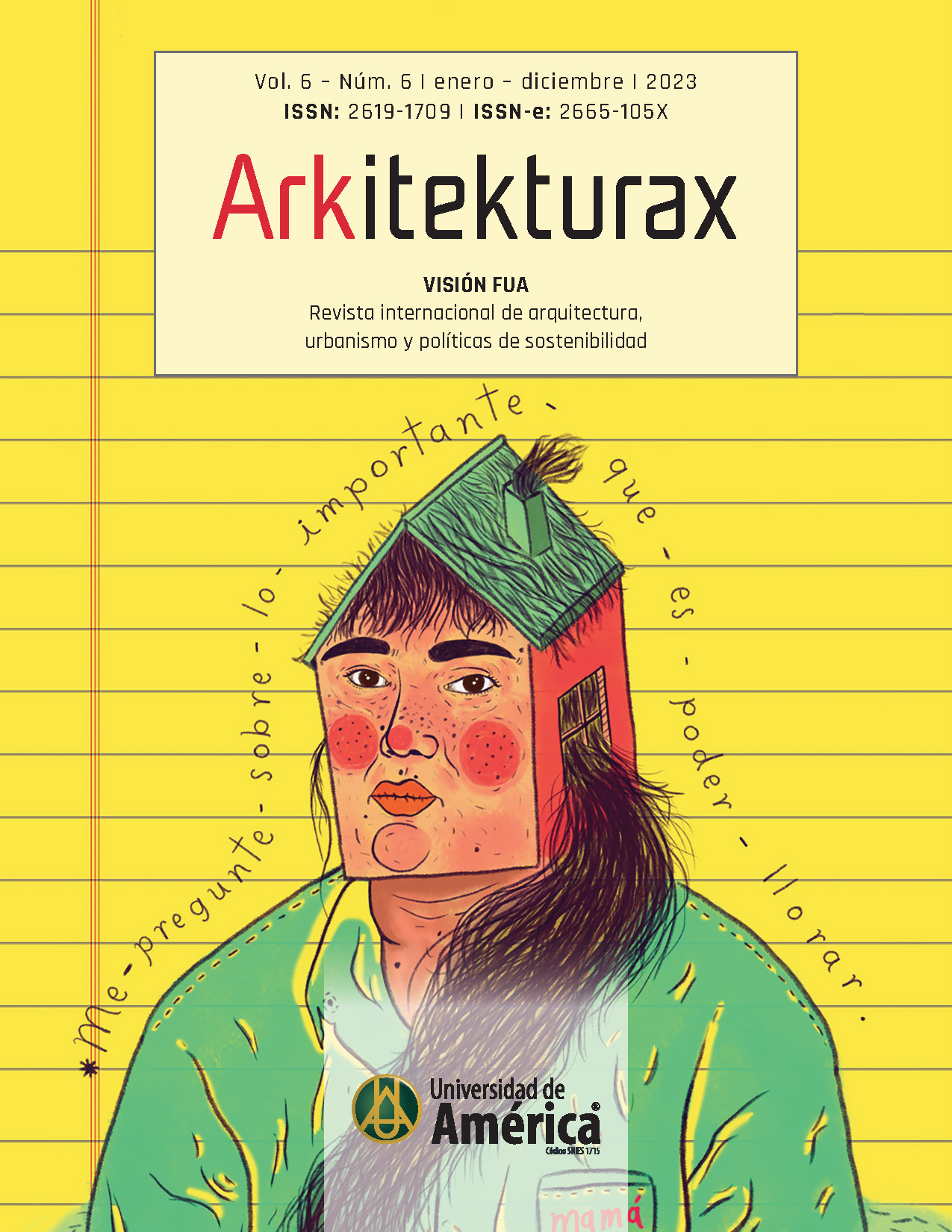
Copyright (c) 2023 Arkitekturax Visión FUA

This work is licensed under a Creative Commons Attribution-NonCommercial-NoDerivatives 4.0 International License.
| Article metrics | |
|---|---|
| Abstract views | |
| Galley vies | |
| PDF Views | |
| HTML views | |
| Other views | |








_8.41_.30_a_. m_._.png)